Teams and teamwork are critical to the overall success of UW–Madison. Across our organization, teams take many forms — including departments, units, committees, sprint squads, research teams, and task forces — bringing three or more people together around shared goals and work.
What makes a team healthy? What makes a team effective? What kind of team environment enables members to truly thrive and contribute to a high-performing team?
Team development is an ongoing process. Any change — big or small — can shift the evolution of a team. This website contains exercises and resources to help you and your team work through the issues you may face at every stage of team development.
Learn more
Questions?
Contact Tamie Klumpyan at tamie.klumpyan@wisc.edu.
Tips to Help You Guide a Team
You can lead or co-lead a session effectively, even if you’ve never done it before. Our Convening with Confidence page can help you prepare.
Characteristics of a Healthy Team
A strong, high-performing team has these traits.
- Healthy teams are intentional and evolve over time.
- They have a clear, shared vision and purpose.
- They communicate openly and effectively.
- Roles and expectations are clearly defined, with shared responsibility for success.
- Trust, dependability, and psychological safety are prioritized.
- They manage conflict and disagreements constructively.
- Successes and efforts are celebrated.
- Every member feels a sense of shared responsibility and accountability for the team’s success.
Adapted from: workhuman
Tuckman’s Stages of Group Development
Bruce Tuckman, an American psychological researcher, developed the model of group development in 1965. The model includes five stages: Forming, Storming, Norming, Performing, Adjourning. The popularity of this model is still cited and applied 50 years later due to its adaptability across different workplace contexts: organizational teams, group projects, committees, or any group of individuals who are working towards common goals.
No matter the purpose or composition of your team, this framework can be used to understand how teams grow, navigate challenges, flourish, and co-create their desired culture.
By identifying which stage your team is in, you can choose an approach that addresses the team’s current needs.
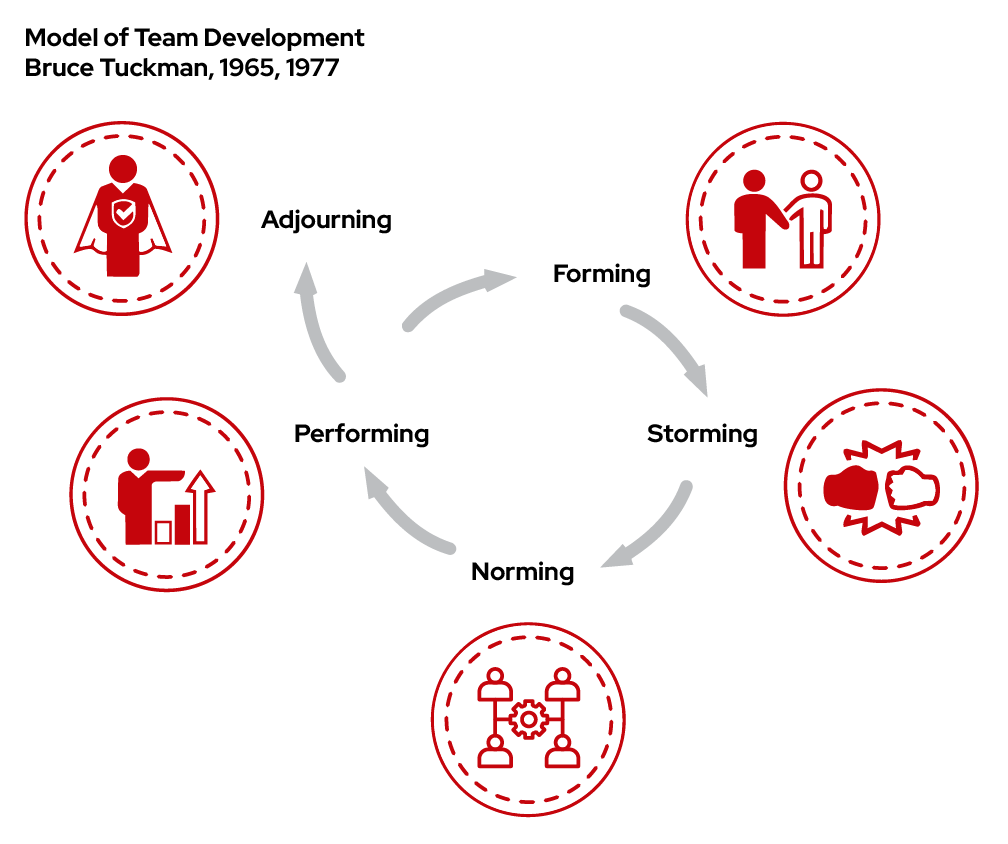
Source: National Institutes of Health, National Cancer Institute Collaboration Team Science Field Guide, NIH Publication No. 18-7660
Important Reminders about Team Development Stages
Team development phases are a roadmap and each team’s journey is unique.
- Team development stages are not always linear. Teams often move back and forth between stages.
- Teams do not always start at the Forming stage. Context matters. When new members join or reorganizing takes place, the team may skip the Forming stage.
- Teams do not sustain the Performing stage automatically or indefinitely. Changes in goals, priorities, or membership can cause a team to move to an earlier stage.
Supporting Your Team at Each Stage
Below, each stage of team development is paired with adaptable exercises and resources with easy-to-follow instructions to guide your team. These are:
- Useful for teams of all sizes
- Structured yet flexible
- Informed by evidence-based practices
- Focused on co-creation and shared responsibility
- Remote-friendly (some adaptation may be required)
- Each exercise includes an estimated timeframe for completion
This is an accordion element with a series of buttons that open and close related content panels.
Forming
Help your team navigate the excitement and cautiousness of getting to know each other and your shared purpose. Building trust early in this stage lays a strong foundation for team success.
Signs you might be in this stage
- Excitement
- Uncertainty
- Curiosity
- Nervousness
- Readiness
- Cautious
Team needs in this stage
- Cultivate team connection
- Build trusting relationships
- Create clarity in purpose, roles, and responsibilities
How to support this stage
Exercises to assist a forming team
These exercises can be used to meet the team’s needs for connection, trust, and clarity in purpose, roles, and responsibilities. All exercises are in-person and remote-friendly.
- Team Check-ins and Check-outs (5–10 minutes)
These brief, powerful practices foster connection and presence in team gatherings. - Four Corners (20–45 minutes)
This team-building activity invites team members to share information about themselves and helps team members get to know each other. - Create Connection: Card Exercise (10–20 minutes)
This exercise uses Chad Littlefield’s We! Connect Cards to create quick connections and encourage brief, yet meaningful, conversations among team members. - Start with Why? (10–15 minutes prep, 30–60 minutes teamwork)
Team members are asked to consider nine questions in advance. This is followed by a discussion about the team’s purpose and how it connects to the organization’s broader mission and vision. - Team Purpose: 20×20 (1–3 hours)
This activity helps the team revisit the outcomes of “Starting with Why?” exercise. It can also be used to re-energize or revisit an existing team purpose.
Resources for forming teams
The following professional development opportunities from Learning and Talent Development provide UW–Madison employees with the tools and skills to help their teams build a foundation for success.
- Impacting Team Dynamics (2.5 hours)
This free, virtual course provides an overview of team roles, the team development process, and the importance of individual impact on team dynamics. The session focuses on the specific actions that can be taken throughout the evolution of a team. - Inclusive Teams: Co-creating Culture, Values and Intentions (3 hours)
In this workshop, participants will learn how to guide their teams in revisiting, revising, and even reimagining how to effectively work together. Units and teams are encouraged to register two or more team members.
Storming
Help your team navigate differences in expectations, priorities, communication, and work styles. Well-managed conflict at this stage can improve cohesion, communication, and innovation.
Signs you might be in this stage
- Hard
- Conflict
- Overwhelm
- Frustration
- Burnout
- Disagreement
- Disharmony
- Potential
- Opportunity
Team needs in this stage
- Identify team and individual needs
- Establish clear and consistent team communication
- Develop a shared understanding of how we navigate conflict
- Build a foundation of trust to engage in hard and helpful conversations
How to support this stage
Exercises to assist a storming team
These exercises can support a group in identifying team and individual needs, communicating clearly and consistently, navigating conflict together, and building a foundation of trust. All exercises are in person and remote-friendly.
- LWHN – Landing What’s Here Now (10–20 minutes)
This exercise helps to surface current experiences in a structured, anonymous way. This practice builds psychological safety, allowing individuals to feel heard without judgment, and promotes shared understanding of the team’s current state, setting the stage for future team dialogue. - Uncertainty Mapping (10–20 minutes)
In this exercise, the team maps uncertainties and challenges and considers whether they are in or outside of their control. This helps identify barriers to progress and team performance. - Designed Alliance: Shared Working Agreements (30–60 minutes)
A Designed Alliance is a shared agreement between two or more team members about how they want to work and be together; especially when expectations may feel misaligned or in conflict. - Needs and Brings (1–2 hours)
This exercise creates space for team members to share what they plan to contribute — through their experience, talents, and commitments — and what they need to thrive and feel motivated, valued, and safe. - Get Unstuck: 15% Solutions (20–30 minutes)
When the team is feeling stuck, uncertain, or in a swirl, this exercise helps to identify small, immediate actions the team can take that are within their influence and control, thereby creating some momentum.
Resources for storming teams
These interactive workshops can equip team conveners and team members to navigate the challenges of the storming stage of team development.
- Giving and Receiving Constructive Feedback (3 hours)
In this virtual, interactive workshop, participants will learn and apply frameworks for both giving and receiving feedback messages to make meaningful changes. - Navigating Difficult Conversations: Healthy and Effective Approaches (3 hours)
This highly interactive workshop, held in person, will provide strategies and tools for navigating difficult conversations. Participants will practice using the POISE model.
Norming
Help your team recognize and use their collective strengths through collaboration. Healthy teams thrive when members feel safe to share ideas and concerns without fear of judgement.
Signs you might be in this stage
- Hopeful
- Reassuring
- Connection
- Pride
- Predictability
- Growth
Team needs in this stage
- Build a shared group identity
- Promote psychological safety
- Identify and process challenges effectively
- Create opportunities to learn and grow
- Identify standard operating procedures
- Sustain team connection
How to support this stage
Exercises to assist a norming team
These exercises help to foster shared group identity, psychological safety, and team connection. Teams can identify and process challenges effectively, identify standard operating procedures, and create opportunities to learn and grow. All exercises are in-person and remote-friendly.
- Team Communication Charter (30–90 minutes)
The team works together to co-create a communication charter that identifies the understood norms team members will use to access and provide information across the team and in their collective work. - BRAVING: Anatomy of Trust (45–60 minutes)
In this exercise, team members explore a research-based model of trust called BRAVING, which provides a framework for team dialogue about what builds trust and what can erode it. - Future Headlines: Aligning Vision with Values (30–45 minutes)
This exercise invites team members to imagine future possibilities together. This normalizes that change is a part of growth, uses shared values as a compass forward, and strengthens commitment. Team members see their ideas reflected in the future state.
Resources for norming teams
These workshops support teams during the norming stage of team development, providing skills and tools in areas such as interpersonal relationships and building and maintaining trust.
- Working Better Together: Everything DiSC (3-hour workshop)
Everything DiSC Workplace uses a validated assessment tool to gain greater awareness of one’s own—and others’ interpersonal tendencies and motivations, helping participants discover new ways to connect, collaborate, and communicate with others. This course is not available virtually and requires a fee per individual to cover the cost of the online Everything DiSC Workplace assessment. - Building Trusting Working Relationships (3-hour workshop)
This free course teaches participants how to build and maintain trusting relationships through intentional words and actions. Participants learn how to set appropriate boundaries and confront distrust with a five-step conversation.
Performing
Help your team maintain cohesion, efficiency, and effectiveness. Stay flexible and adaptable to sustain a healthy team culture and provide growth opportunities to keep members engaged.
Signs you might be in this stage
- Impactful
- Collaborative
- Confidence
- Flow
- Harmony
- Alignment
Team needs in this stage
- Cultivate ongoing appreciation, recognition, and gratitude
- Capture organizational knowledge
- Invite autonomy, proactivity, and experimentation
How to support this stage
Exercises to assist a performing team
At the performing stage, teams have an opportunity to capture organizational knowledge and invite autonomy, proactivity, and experimentation. These exercises encourage collaboration and continuous improvement. All exercises are in-person and remote-friendly.
- Start-Stop-Continue (30–60 minutes)
This exercise provides a feedback and continuous improvement tool, helping teams reflect on their work and identify specific actions or processes to adjust moving forward. - Project Collaboration Tool (ongoing)
This tool helps teams working on multiple collaborative projects to track task progress, deadlines, and overall project status. Shared access to team processes and information is essential, especially in remote or hybrid environments. - Team Process Improvement (60+ minutes and ongoing)
This exercise helps teams map their current workflows and identify small but meaningful improvements to their standard operating procedures.
Resources for performing teams
These professional development opportunities can help teams maintain cohesion, efficiency, effectiveness, and adaptability.
- Project Management Basics (3.5 hours)
This course, offered both virtually and in person at no cost, provides a broad overview of the phases of project management that people who are not professional project managers can use to make their work on projects more effective. - Effective and Engaging Meetings (2.5 hours)
This free course provides information anyone can use to make meetings more engaging and inclusive.
Adjourning
Signs you might be in this stage
- Gratitude
- Grief
- Relief
- Loss
- Surprise
- Closure
Team needs in this stage
- Reflect, collect, and/or archive what was learned
- Provide support in transition
- Celebrate the achievements and relationships
How to support this stage
Exercises to assist an adjourning team
Team exercises can help the team reflect, collect, and/or archive what was learned, while celebrating achievements and relationships. These activities support an intentional transition as the team adjourns. All exercises are in-person and remote-friendly.
- Bragitude (15–20 minutes)
What is a Bragitude? It is a combination of celebration and gratitude. It is a reminder to take time and name the team wins, reinforcing positive reflection, giving and receiving feedback, and team celebration. - Artful Closer (20–45 minutes)
This exercise offers time for team member reflection and uses art and interpretation to consider the impact of the group’s work prior to adjourning. - Retrospectives (2–3 hours)
The value of retrospectives comes from having a safe space for dialogue and feedback. Through discussion in a group setting, teams can understand why things occurred, how to replicate positive outcomes, and lessons learned that can be applied to future teamwork. - Guide to Adjourning (ongoing)
Teams often rush through an intentional adjournment or skip it entirely. A checklist ensures that important steps — such as recognizing contributions, capturing lessons, archiving files, and clarifying handoffs —aren’t overlooked.
Join the Healthy Teams CoLab
Learning and Talent Development has created this collaborative, generative space to explore team challenges, work through exercises together, and share additional resources. We will be hosting virtual or in-person sessions to practice team exercises and explore team development with others. All levels of experience are welcome.